After much delay, welcome to our final November rewrite! This one's a bit special because it's actually a rewrite of our second-ever "guest piece" by our friend, photographer, railfan, and Milwaukee native Jonathan Lee. As a love-letter to Milwaukee and its interurbans, it was a fantastic piece; but for a reader, it was a bit too lengthy! That's why we're condensing and refining the best parts of his report, in fairness to the work he did for us and the quality you, the riders, expect from Twice-Weekly Trolley History! While Milwaukee is famous in heavy-rail circles as forming part of the legendary Milwaukee Road, its streetcars and interurbans are equally as legendary, skirting the fine line between innovation and insolvency. On today's Trolley Tuesday, we raise our beer mugs high as we look at what's made Milwaukee famous to traction fans!

Your dose of streetcar and interurban history from the United States and around the world, every Tuesday and Thursday!
Showing posts with label Guest Piece. Show all posts
Showing posts with label Guest Piece. Show all posts
Tuesday, December 7, 2021

Thursday, May 6, 2021
Trolley Thursday 5/6/21 - The Key System
In the annals of East Bay history, no other names holds as much legend and iconic imagery as Oakland's Key System. Developed as yet another interurban real estate scheme, the eight lines of the Key System helped to develop much of East Oakland and Berkeley. The Key System maintained its dominant position in East Pay transit after the opening of the San Francisco-Oakland Bay Bridge and widespread adoption of the automobile. Unfortunately, much like its contemporaries in Los Angeles, El Paso, Texas, and San Diego, the Key System fell victim to the same machinations that brought down dominant private interurbans like it in the form of the infamous National City Lines. On today's Trolley Thursday, let's hop aboard a Bridge Unit and rediscover the rich history of one of America's iconic street railways.
Tuesday, May 4, 2021
Trolley Tuesday 5/4/21 - The Southern Pacific's East Bay Electric Lines
Once again, welcome to another new month of Trolleyposts by your conductor and your motorman! This month, we're still in the Bay Area but we're now crossing the Bay Bridge to get to the East Bay cities of Oakland, Alameda, and Berkeley. Long before this massive bridge was here, the East Bay was full of streetcar lines that were, eventually, replaced by the now-familiar Bay Area Rapid Transit (BART) and the Bay Bridge. On today's Trolley Tuesday, we start our journey off in Oakland as we look at the Southern Pacific Railroad's other interurban holding, the Oakland, Alameda & Berkeley Lines. Of course, in hindsight, we now know this as the East Bay Electrics (EBE) and who knows? We might even see some familiar faces along the way!
Friday, July 31, 2020
Trolley Thursday 7/30/20 - Guest Piece - Milwaukee Streetcars by Jonathan Lee
Welcome to the last Trolley post of July! As is tradition now with our transit experts of the month, we delegate onto them a guest post to write and have them impart their knowledge directly onto you, the unwilling captive and interested audience. For this month, our expert, Jonathan Lee, has written for you a concise history on the city of Milwaukee's interurban and streetcar operations. There's a lot to be said, but from us here at Twice Weekly Trolley History, thank you for reading our material, for giving us the biggest readership we've ever seen, and we hope you all stick around for more in the future. Mr. Lee, you have the floor!
(Also all photos today are credited to Joseph Canfield, author of "TM, The Milwaukee Electric Railway & Light Company," unless otherwise noted. Find the book link in the epilogue.)
(Also all photos today are credited to Joseph Canfield, author of "TM, The Milwaukee Electric Railway & Light Company," unless otherwise noted. Find the book link in the epilogue.)
Thursday, May 28, 2020
Trolley Thursday 5/28/20 - A Utahn Reflection by Josh B.
To close off this month's discussion of Utah streetcars, trolleys, and mostly interurbans, I've asked my Utah expert this month, Josh B., to write up a guest piece. This is going to be a regular practice considering I have friends with an interest in streetcars all over the United States, and possibly even the world. I'll probably think up a better name than "Guest Piece" though. Without further ado, take it way, Josh!
-----
 |
| Bamberger No. 353, southbound leaving Kaysville (Gordon Cardall) |
 |
| Magna, Utah in 1937, with a Salt Lake & Utah train in the distance. (Don Strack) |
 |
| Salt Lake & Utah steeplecab No. 101 switches freight cars as parlor car 751 passes by on the main. (Gordon Cardall) |
In a previous post, your Motorman highlighted a boxcar that was purchased by the Salt Lake & Utah, but diverted to the Salt Lake Garfield & Western when payment was not forthcoming. This is a single example of the SL&U's extensive freight roster of refrigerator cars, drop bottom gondolas, boxcars, and flatcars. The Utah-Idaho Central boasted a similarly sized selection of freight cars, largely utilized for the sugar beet and fruit traffic originating on its far-flung agricultural branches to Plain City and North Ogden. The Bamberger had a smaller freight roster, but its 50-foot paper service boxcars could be seen as far away as Denver, where they drove the Denver & Rio Grande Western employees mad due to deferred maintenance and constant malfunctions.
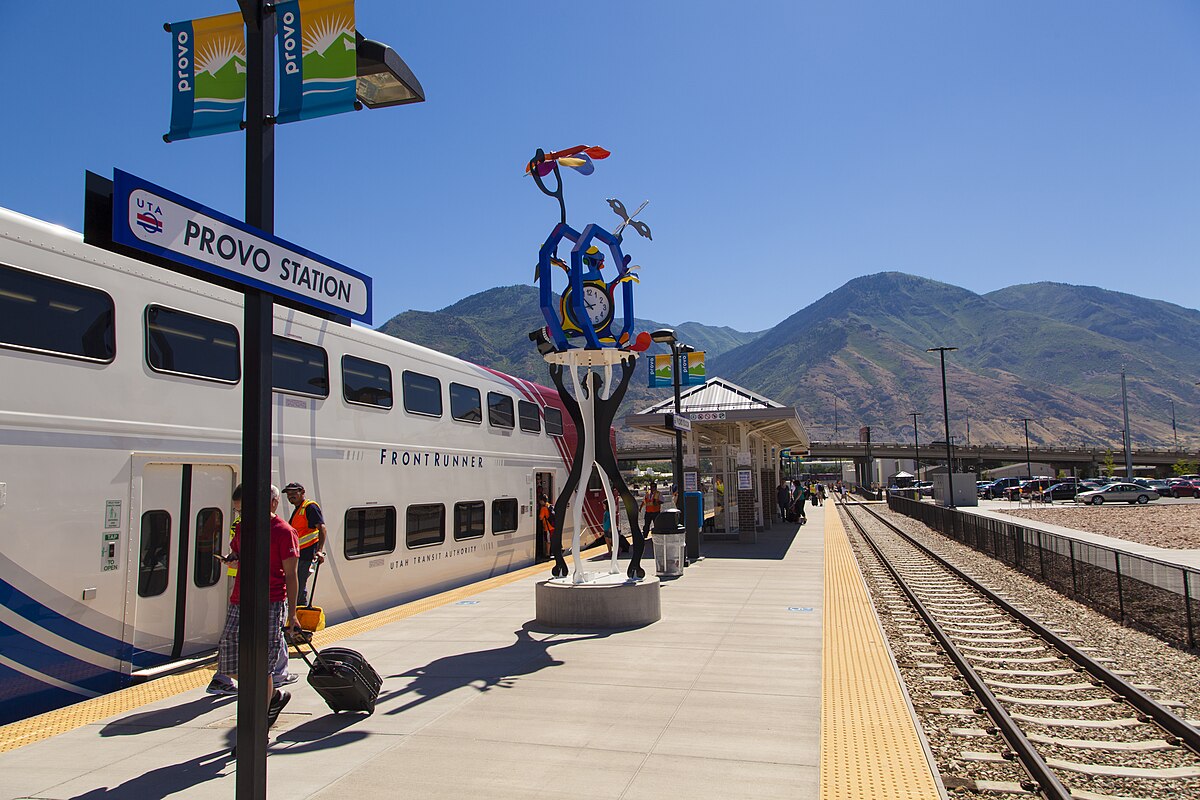 |
| The new Frontrunner heavy-rail commuter service at Provo Station, formerly served by the Bamberger Railroad. (Ricardo63) |
Their position paralleling the D&RGW and the Union Pacific along the Wasatch Front forced the larger steam railroads to offer competitive pricing for local traffic, a pleasant side effect that assisted the economic advancement of the otherwise isolated rural populations. North Ogden residents still fondly remember the “Dummy Line,” the UIC's branch up to the North Ogden Bench, but visit the North Ogden Historical Museum and the narrative focuses on its importance in developing the orchards that thrived at the base of Mount Ben Lomond, not the streetcar services it also provided.
 |
| Ogden City Railway No. 100, year unknown but a perfect example of a steam dummy (Don Strack) |
 |
| A Utah-Idaho Central interurban unloads in the middle of the street at Logan, UT, heading Northbound, 1947. (Gordon Cardall) |
/arc-anglerfish-arc2-prod-sltrib.s3.amazonaws.com/public/PIJMOGPDXNHTHEOQNVLKGGSU6U.jpg) |
| The Salt Lake Tribune) Gov. Gary Herbert speaks as UTA celebrates its 50th birthday with a news conference at the state Capitol in Salt Lake City on Tuesday, March 3, 2020. At left is Carolyn Gonot, executive director of UTA. (Trent Nelson, Utah Tribune) |
This year Utah Transit Authority is celebrating its 50th year; the anniversary stickers adorning all Frontrunner and Trax cars represents that the state is slowly remembering the importance of a publicly accessible passenger rail system. As we acknowledge the interurban renaissance, remember that the interurbans also built the state's industry just as much as its public transport, and look forward to a day when, as urban planners and futurist dreamers predict, an electrified rail network once again stretches from the Idaho border to southern Utah County, and perhaps this time beyond.
 |
| UTA's Trax Light Rail service, continuing the legacy of electric mass transit. (Bond Buyer) |
-----
Subscribe to:
Posts (Atom)